
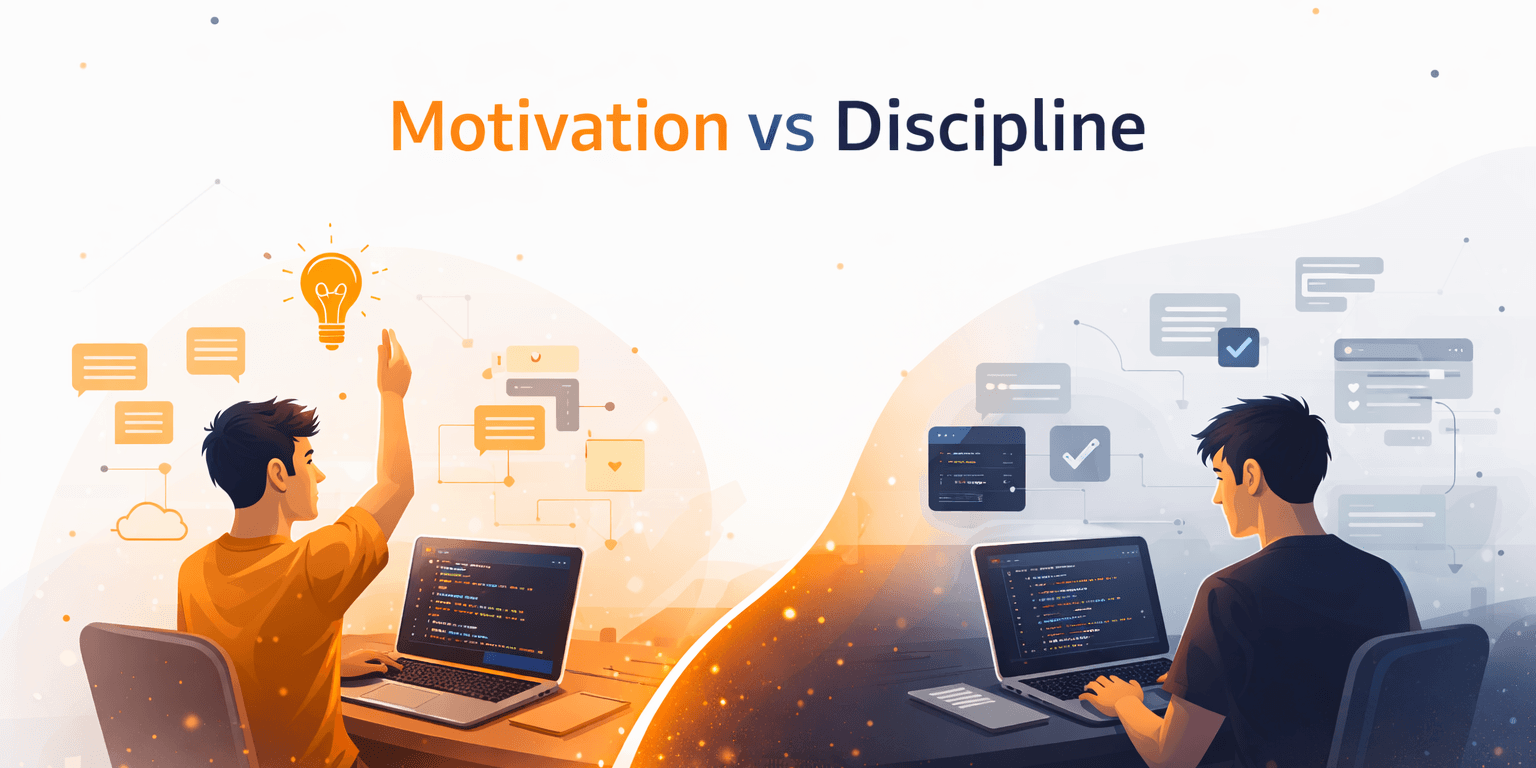
At the beginning of any learning journey, people often feel a strong burst of energy that pushes them to start with enthusiasm. They open courses, create plans, and feel capable of achieving significant progress in a short period of time. This feeling is known as motivation, and it is what drives you to take the first step. However, the real challenge most people face is not starting, but continuing.
After a few days or weeks, that initial excitement begins to fade. Tasks start to feel heavier, focus becomes harder, and a subtle urge to delay or avoid work appears. This is where doubt begins to grow, not about the goal itself, but about your ability to keep going. Why does it suddenly feel harder, even though you started with so much energy?
The real reason is that motivation is not stable by nature. It is a feeling that changes depending on mood, environment, and mental energy. It can be strong at one moment and completely disappear in another. Because of this, relying on motivation alone becomes risky, as it cannot be controlled consistently.
In contrast, there is another concept that is far more reliable: discipline. Discipline does not depend on how you feel, but on what you decide to do. It is the ability to continue working even when you do not feel like it. This is what allows you to move forward when motivation disappears. That is why discipline is often seen as the key factor behind long-term success, while motivation is simply the starting spark.
The relationship between the two can be understood clearly through a simple idea. Motivation helps you begin, but discipline is what keeps you going. You might start learning because you feel excited, but you will only continue if you are committed. Over time, it becomes clear that discipline is what turns effort into results.
In programming, this difference becomes very obvious. Many people begin with strong motivation, learn the basics quickly, and feel like they are making rapid progress. But when they reach more challenging stages, such as understanding complex concepts or building real projects, they begin to slow down or even stop. This does not happen because they are incapable, but because they were relying on motivation alone.
The developers who succeed are not necessarily the most motivated, but the most consistent. They are the ones who sit down to learn even when they do not feel like it, who write code even when it feels difficult, and who keep trying even after failing. This kind of behavior does not come from motivation, but from discipline.
It is also important to understand that discipline does not mean forcing yourself harshly or working under constant pressure. Instead, it is about building small habits that are repeated daily. Over time, these habits become part of your routine, and the act of working no longer requires strong motivation. This is when real progress begins to happen, because consistency replaces emotional fluctuation.
One of the most interesting aspects of this topic is that motivation does not always come before action. In many cases, it appears after you start working. When you begin a task despite not feeling motivated and make even small progress, motivation starts to build naturally. This means that discipline can actually create motivation, not just depend on it.
This completely changes the way you approach your work. Instead of waiting for the “right mood,” you begin working regardless of how you feel, and the motivation follows. This is the mindset that separates those who keep starting over from those who actually move forward.
The real problem, then, is not losing motivation, but depending on it as a requirement for action. People who wait until they feel motivated often remain stuck at the starting point. Meanwhile, disciplined individuals continue moving forward, even without that feeling, and eventually achieve far better results.
In the end, motivation still has its place. It is important for starting, and it can give you a push when you need it. But it is not enough to carry you through the entire journey. Long-term success, especially in fields like programming, depends on your ability to continue despite difficulty, and that ability comes from discipline.
So the real question is no longer: are you motivated today?
But rather: will you work even when you are not?