In recent years, the way people learn programming has changed dramatically.
It is no longer limited to universities. Today, anyone can start learning from scratch using online resources and potentially reach a professional level without ever attending a formal class.
This shift raises an important question:
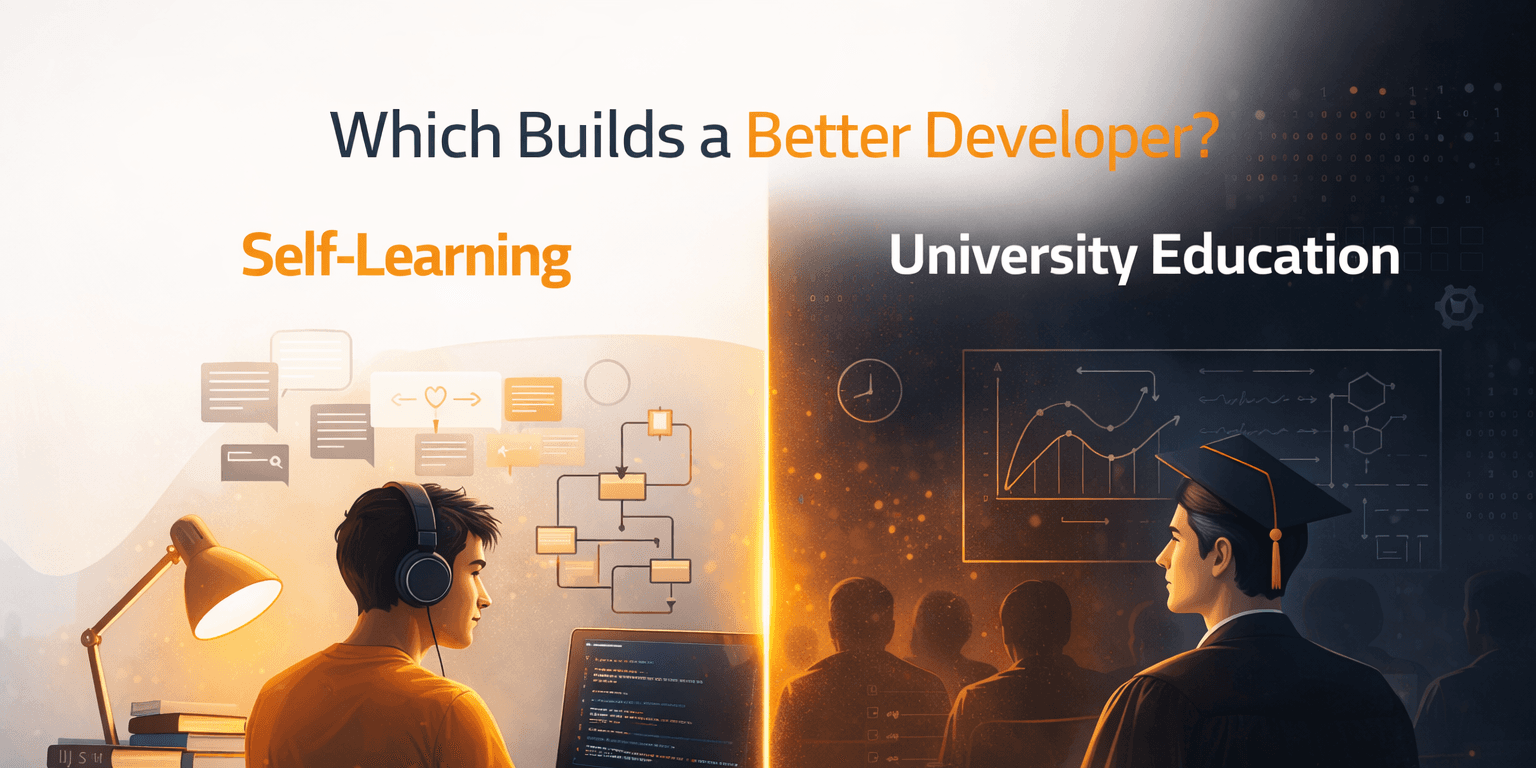
Which path is better — self-learning or university education?
To answer this properly, we need to go beyond a simple comparison and understand what each path truly offers.
Self-Learning: Freedom That Can Turn Into Chaos
When someone chooses self-learning, they enter an open and flexible environment.
They can decide what to learn, when to learn it, and how to approach it.
This flexibility is the biggest strength of self-learning, but it can also be its biggest weakness.
Many self-taught learners struggle with one core issue:
the lack of a clear path.
They may spend months jumping between tutorials and courses without building a solid foundation, or they may learn advanced topics before understanding the basics.
However, self-learning offers one major advantage:
a strong focus on practical skills.
Most self-taught developers tend to build real projects early on, which makes them closer to job requirements where hands-on experience is essential .
University Education: The Foundation That Takes Time
On the other hand, university education provides a completely different experience.
Instead of choosing your own path, you follow a structured curriculum designed to build deep knowledge over time.
You learn:
-how algorithms work
-how systems are designed
-why technologies behave the way they do
This kind of understanding may not show immediate results, but it creates a strong foundation that helps you adapt to new technologies later in your career.
Universities also offer a structured environment, mentorship, and opportunities to collaborate with others, which can play a significant role in professional growth .
The Real Problem
The issue is not choosing between the two paths, but believing that one of them is enough on its own.
Many university students rely only on lectures and graduate without strong practical skills.
At the same time, many self-taught developers can build projects but lack the deeper understanding needed to grow further.
The reality, as many developers discover, is simple:
Self-learning and university education are not competing paths — they complement each other .
Speed vs Sustainability
If your goal is to enter the job market quickly, self-learning is often the faster option.
You can gain practical skills within months, especially in fields like web development.
However, if your goal is long-term growth, university education provides a deeper foundation that makes learning new technologies easier over time.
This is where the real difference appears:
-Self-learning gives you speed
-University education gives you long-term strength
The Right Approach: Combine Both
The most successful developers today do not rely on a single learning method.
A strong university student:
-learns beyond the curriculum
-builds real projects
-stays updated with modern tools
A successful self-taught developer:
-focuses on fundamentals
-follows structured resources
-avoids learning randomly
Conclusion
There is no single “best” way to learn programming.
Each path offers a different kind of value.
What truly matters is not the path you choose, but how you use it.
A great developer is not someone who only studied at a university, nor someone who only learned independently,
but someone who combines deep understanding with practical skills.
That is the real difference between learning programming… and becoming a developer.